

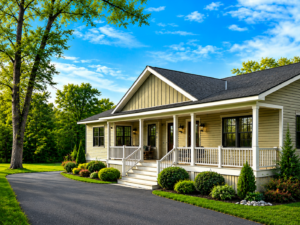
A modular home is built in sections to your state’s local building code and set permanently on a foundation, which means it is legally treated as real property from day one, the same as a home built entirely on site. A manufactured home is built to a single federal standard called the HUD Code, and depending on how it’s placed and titled, it can be classified as real property or personal property. That classification difference is the single biggest factor separating the two home types, and it determines what kind of loan you can get, what your interest rate looks like, and how the home is taxed for the rest of the time you own it.
Owl Homes of Fredonia builds and places both modular and manufactured homes across Western New York and Northwestern Pennsylvania, and our team walks every buyer through the financing, foundation, and resale implications of each before any decision is made.
A modular home is constructed in sections inside a climate-controlled factory, transported by flatbed, and assembled on a permanent foundation at your home site using a crane. The defining detail is the code. Modular homes are built to the same state and local building codes that govern a traditionally built home in New York or Pennsylvania, not a separate federal standard. That single fact unlocks conventional mortgage financing, FHA loans, VA loans, and standard homeowner’s insurance, the exact same products available to a buyer building entirely on site. At Owl Homes, every modular home we deliver is built to the specific state code of wherever it’s headed, NY code for our New York deliveries and PA code for our Northwestern Pennsylvania buyers.
A manufactured home is also built entirely indoors in a factory, but to the federal HUD Code rather than a state or local standard. Did you know that the term “mobile home” technically only applies to factory-built homes constructed before June 15, 1976, the date the HUD Code took effect? Anything built after that date is legally a manufactured home, and today’s manufactured homes look nothing like the trailers that term used to bring to mind, open floor plans, modern kitchens, vaulted ceilings, and finish packages that rival a traditionally built home. The construction method isn’t what limits a manufactured home. The classification does.
This is where the two paths genuinely diverge, and it’s the part of the decision that has the biggest dollar impact. Because a modular home is real property from the moment it’s set, it qualifies for the same construction-to-permanent loan structure as a site-built home, short-term construction financing that converts into a standard mortgage once the home is finished and inspected. Conventional, FHA, and VA loans are all available, with the same rate environment and underwriting standards applied to any other home purchase in the same market.
A manufactured home’s financing path depends entirely on how it’s titled. If the home is permanently affixed to land you own and the vehicle title is retired, it can often qualify for a conventional mortgage, an FHA loan, or even programs designed specifically for manufactured homes built to higher standards with site-built features like covered porches and pitched rooflines. If the home isn’t titled as real property, financing typically shifts to a chattel loan, a personal property loan similar in structure to financing a vehicle. Chattel loans are widely used and accessible, but they generally carry a different rate structure than a conventional mortgage, which is a meaningful detail to understand before you sign anything. This is exactly the kind of conversation our team has with every buyer during consultation, and it’s part of why we never quote a number without first understanding your land and your financing goals.

Modular homes are set exclusively on permanent foundations and inspected to the same standard as any site-built home in your county. Manufactured homes can be placed on a wider range of approved foundation types, which gives buyers more flexibility on certain lots, particularly where soil conditions or budget make a full poured foundation less practical. Neither approach is universally better. The right fit depends entirely on your specific land, your timeline, and your long-term plans for the property.
Resale and appraisal. A modular home on a permanent foundation is appraised and resold exactly like a site-built home in the same market, foundation type and location drive long-term value, not the construction method. A manufactured home’s resale trajectory depends heavily on whether the land is owned and the title is retired as real property.
Taxation. Modular homes are taxed as real property from day one, the same as any traditionally built house. Manufactured home taxation depends on classification, and that can shift over time if the home’s status changes.
Customization. Modular construction gives buyers more flexibility on layout, finishes, and structural features before the build begins, since every section is built to your specifications from the start. Manufactured homes are typically built from a more standardized set of floor plans, though the finish-level options have expanded significantly in recent years.
Both modular and manufactured homes are built indoors under controlled conditions, which eliminates weather delays during framing and keeps material waste tightly controlled compared to a job site exposed to the elements. Quality inspections happen at every stage of production, not just at the end. The building envelope on a factory-built home is frequently tighter than a comparable site-built home because the assembly happens indoors rather than in the field, insulation fills correctly the first time, and there are no gaps from rushed framing in bad weather. Once a modular or manufactured home is finished, sided, and landscaped, it is visually indistinguishable from a home built entirely on site, a detail most first-time buyers don’t expect until they see it in person.
The fastest way to understand which fits your situation is to walk through both. Our campus at 3752 East Main Road in Fredonia, NY has close to $2 million in model homes on display, including modular and manufactured options across our Cavco Homes, Manorwood Homes, Champion/Skyline, and New Era Homes lineups, and there’s no appointment needed to tour. Tour 2 Million Dollars in Homes on Display.
Whether you’re in Buffalo, anywhere across Erie County NY, or across the state line in Northwestern Pennsylvania, our team has been helping buyers work through exactly this decision for over 50 years.
Want to talk through your specific land and financing situation? Call us at 716-673-1366, or visit our contact page to schedule a consultation. You can also browse our full home lineup online before your visit, or follow our progress on Facebook to join our community and catch every home tour, install, and article as it goes up.
What is the main difference between a modular and a manufactured home?
Modular homes are built to state and local building codes and are always set on permanent foundations, which classifies them as real property. Manufactured homes are built to the single federal HUD Code, and depending on how they are titled and placed, they can be classified as real property or personal property.
Can a modular home get the same financing as a site-built home?
Yes. Modular homes on permanent foundations typically qualify for conventional, FHA, and VA financing, the same loan products available for a traditional site-built home in the same market.
Why might a manufactured home’s financing be different?
Financing depends on classification. A manufactured home permanently affixed to owned land with the title retired as real property can often qualify for a conventional or FHA loan. If it’s not titled as real property, financing typically shifts to a chattel loan, a personal property loan structure.
Can I tour both modular and manufactured homes at Owl Homes of Fredonia?
Yes. Our Fredonia campus displays both modular and manufactured models across our full manufacturer lineup, and no appointment is needed to walk through them.
Is one option better than the other?
Neither is universally better. The right choice depends on your land, your budget, your financing goals, and your long-term plans, which is exactly what our team works through with you during a consultation.
Article & Imagery by Nicholas Bellanti